Your brand is your most valuable asset, but in today's market, it's under constant threat from counterfeiters. A fake product with your name on it can destroy customer trust and slash your profits overnight.
You need a security solution that is both visually obvious to your customers and technically difficult for criminals to copy. Standard printed labels just don't offer this level of protection, leaving your brand vulnerable.
Hologram labels provide an immediate and powerful defense by using micro-embossed patterns to manipulate light into complex, three-dimensional images. This optical technology is nearly impossible to replicate with conventional scanners or printers, creating an easily verifiable mark of authenticity.
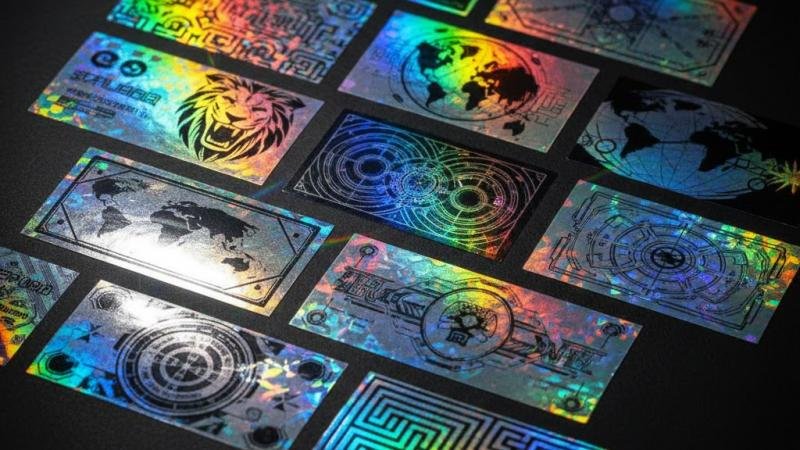
Over the years, many clients have come to me looking for a "shiny sticker" to make their product look more premium. Their initial focus is always on the aesthetics. My first step is always to reframe the conversation. I tell them that designing a successful hologram isn't about picking a 'pattern'; it's about engineering a multi-layered ‘Optical Barrier’. The strength and complexity of this barrier must be directly proportional to the value of the brand you are protecting and the sophistication of the counterfeiters you are fighting. This guide is designed to walk you through that strategic process.
How Do Hologram Labels Use Light to Protect Your Brand?
You see the vivid, floating image, but how does a flat label achieve this magical effect?
The secret isn't ink; it's a field of applied physics known as diffractive optics.
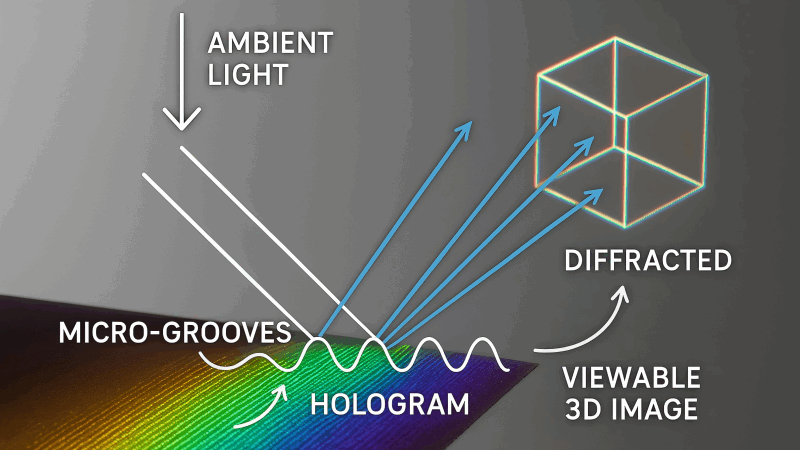
A hologram is essentially a microscopic recording of a light field, not an image made with pigment. The process works in three stages:
- Origination (Recording): A master hologram is created using high-powered lasers. A single laser beam is split in two. One beam illuminates the object or 3D model, and its reflection is recorded on a photosensitive plate. The second beam, the reference beam, is aimed directly at the plate. The interference pattern where these two beams meet is what records the holographic information.
- Replication (Embossing): This microscopic interference pattern is then transferred to a metal plate (a shim). Through a high-pressure, high-temperature embossing process, this pattern is stamped onto rolls of specialized polyester or BOPP film. This creates a surface covered in thousands of tiny, precise grooves per millimeter.
- Activation (Viewing): When normal white light from any source hits these micro-grooves, it is diffracted—split and bent—into its component colors. This diffracted light reconstructs the original light field that was recorded, making the 3D image appear to the viewer. This is why the image changes color and perspective as you tilt it.
Beyond Anti-Counterfeiting, What Business Value Can Hologram Labels Add to Your Product?
You're rightly focused on stopping fakes, but is that the only return on this investment?
Absolutely not. A strategically designed hologram is a dual-purpose asset. It acts as both a security guard and a marketing agent right on your product.
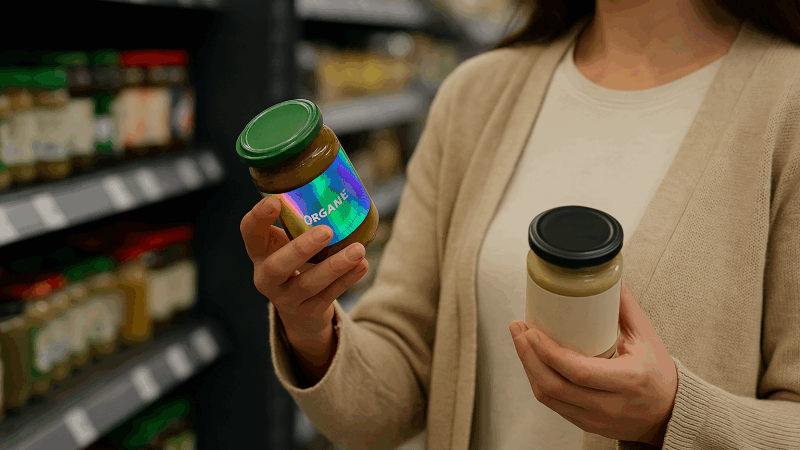
While its primary role is security, the secondary benefits in branding and sales are significant. Many of my clients report positive impacts that they hadn't initially considered.
- Enhanced Brand Perception: Holograms are intrinsically linked with technology and premium quality. Applying one to your product instantly elevates its perceived value. It communicates to the customer that this is an innovative, high-quality item worthy of their money and trust.
- Increased Shelf Visibility: In the visually chaotic environment of a retail store, a product has seconds to capture a buyer's attention. The dynamic, colorful shimmer of a hologram is an eye-catcher. It differentiates your product from the competition and can be the deciding factor that leads a customer to pick it up for a closer look.
- Boosted Consumer Confidence: In a market flooded with fakes, consumers are becoming more cautious. An overt security feature like a hologram gives them an immediate and easy way to verify authenticity. This feeling of assurance reduces purchase anxiety and builds the foundation for long-term brand loyalty.
What Are the Differences Between 2D, 3D, and Dot-Matrix Holograms?
You’ll hear suppliers use these terms. What do they actually look like and what do they mean for security?
These terms describe the technology used to create the master hologram. Each represents a distinct step up in visual complexity, cost, and the strength of the "Optical Barrier."
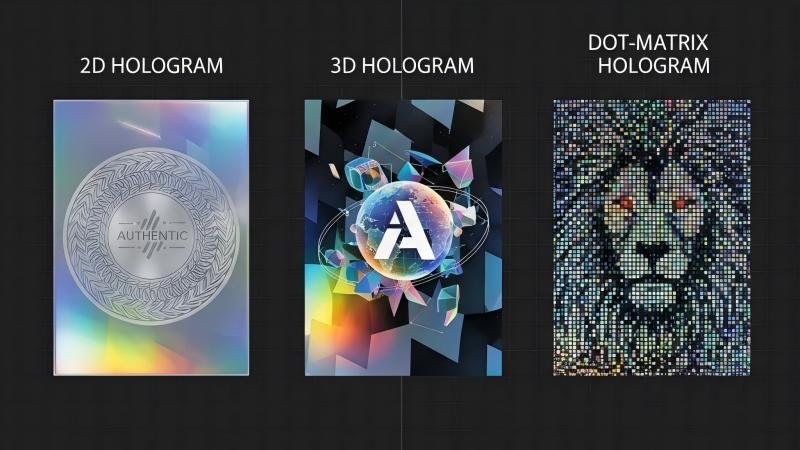
Understanding these three tiers is the first step in aligning your security investment with your actual risk level.
| Hologram Type | Visual Characteristics | Security Level | Best For... |
|---|---|---|---|
| 2D/3D (Layered) | Multiple two-dimensional images (like logos or text) are placed on different layers. Tilting the hologram reveals different layers, creating a simple illusion of depth. | Standard. Provides a good, cost-effective deterrent against casual copying. | Event tickets, promotional giveaways, basic product authentication on lower-value goods. |
| 3D (True Color) | A single, continuous image that appears as a solid, three-dimensional model. It looks like a realistic miniature sculpture captured within the label. | Medium-High. Requires more sophisticated origination technology than 2D/3D. | Brand protection for high-value consumer goods like electronics, cosmetics, and auto parts. |
| Dot-Matrix | A computer-generated array of millions of microscopic dots (pixels). Each dot is a tiny diffraction grating. This allows for complex animations, kinetic effects, and photographic detail. | Very High. Extremely difficult to reverse-engineer and requires expensive, specialized equipment. | High-security documents like banknotes and passports, and high-risk products like pharmaceuticals. |
Which Type of Holographic Security Level Does Your Product Actually Need?
Should you always choose the most complex technology, like Dot-Matrix?
No. That can be a costly mistake. The most effective security strategy isn't about buying the strongest possible lock; it's about choosing the right lock for the door.
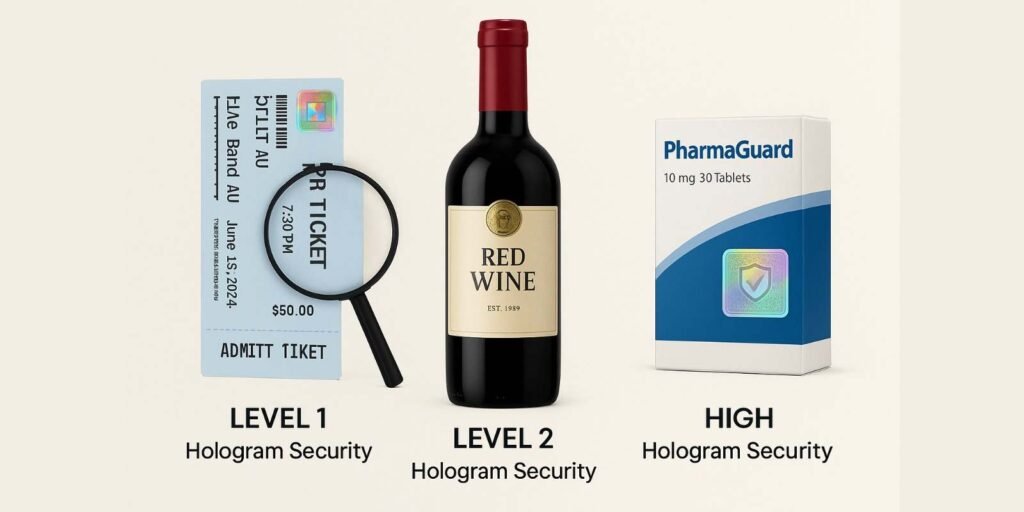
The core of my "Optical Barrier" philosophy is this: your security investment should scale with your risk. A threat assessment is the most critical first step.
- Low-Level Threat (Casual Counterfeiting): If you're protecting promotional items, event tickets, or low-cost consumer goods, the threat comes from individuals with basic printing capabilities. A 2D/3D Layered hologram is more than sufficient. It's a clear visual deterrent that is highly effective in this scenario.
- Medium-Level Threat (Organized Counterfeiting): For products like designer apparel, electronics, or premium spirits, you face more organized counterfeiters with better funding. You need a stronger barrier. A True Color 3D hologram, often combined with a custom feature like microtext, provides a robust and professional defense.
- High-Level Threat (Sophisticated Forgery): When protecting government documents, pharmaceuticals, or critical industrial parts, you are up against sophisticated forgers with significant resources. Here, you must deploy the strongest barrier. A Dot-Matrix hologram with multiple, layered security features (both overt and covert) is the only responsible choice.
What Key Security Features Should You Consider When Customizing a Hologram Label?
Beyond the basic type, how can you make your hologram truly unique and secure?
A world-class "Optical Barrier" is built with layers. You combine the main holographic effect with other overt (visible) and covert (hidden) security features to make it a nightmare for counterfeiters.
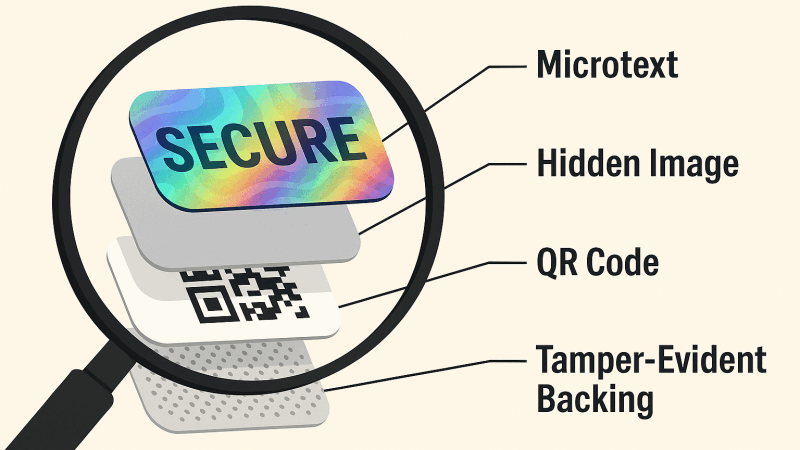
When I work with clients to design a custom hologram, we select a menu of features to create a unique security fingerprint. Here are some of the most effective options available:
- Overt Features (Visible to the eye):
- Microtext/Nanotext: Text so small it requires magnification to read. Extremely hard for scanners to pick up.
- Guilloché Patterns: Intricate, fine-line patterns similar to those on banknotes.
- Kinetic Effects: Animations and movement effects (common in Dot-Matrix) that activate when the label is tilted.
- Covert Features (Hidden):
- UV Ink Printing: A logo or code is printed on the label that is invisible in normal light but glows under an ultraviolet (UV) blacklight.
- Laser-Readable Hidden Image: A specific image or text that is completely invisible until a special laser pointer of a certain frequency is aimed at it.
- Forensic & Functional Features:
- Tamper-Evident Material: The label is made on a frangible or patterned release material. If someone tries to peel it off, it will self-destruct, leaving behind a "VOID" message or a checkerboard pattern, providing clear evidence of tampering.
- Serialized Numbering/QR Codes: Each label is printed with a unique serial number or QR code, allowing for digital track-and-trace verification.
Conclusion
A hologram label is not a mere product feature; it is a strategic defense system. By designing it as a layered "Optical Barrier," you create a powerful tool that protects your revenue, enhances your brand, and secures the trust of your customers.
Build Your Brand's Optical Barrier with ProtegoSeal
Stop choosing patterns and start building your defense. The experts at ProtegoSeal specialize in creating custom, multi-layered hologram labels tailored to your specific industry risks. Contact us to design a security solution that gives you and your customers complete peace of mind.