You see that shiny, holographic sticker on your passport's data page, but what is it really for? Many people mistake it for decoration, missing its true, critical purpose in protecting your identity.
A passport security sticker is a clear, tamper-evident laminate applied over your personal data page. Its sole function is to permanently bond with the paper, creating a single unit that will self-destruct and leave obvious evidence if anyone tries to alter your photo or information.
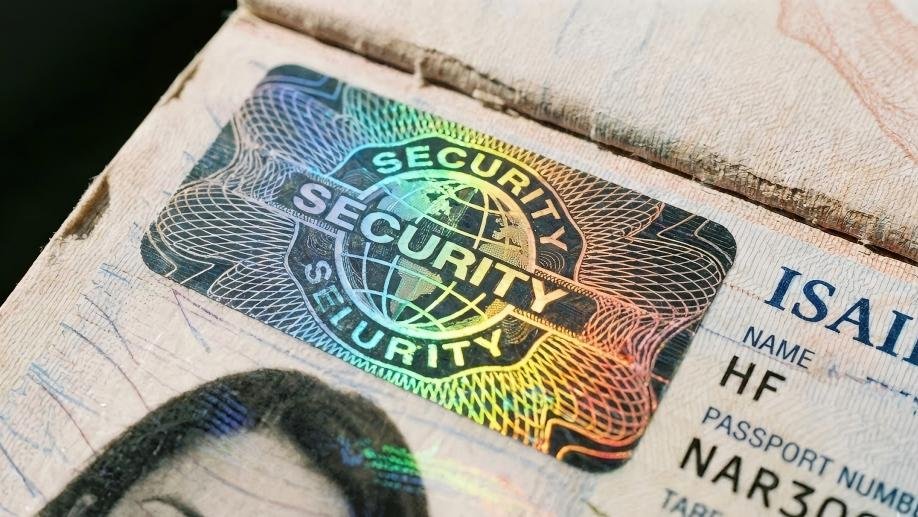
I remember getting my first passport. I was fascinated by the eagle hologram that seemed to float over my photo. I thought it was just a cool, high-tech design choice. It wasn't until I started working with security technologies that I understood the brutal, brilliant function behind it: that sticker isn't there to look good; it's there to fail. Its failure is its success. It’s designed to be a one-way trip; once it's on, it can never come off cleanly. This concept changed how I looked at all security applications.
What Exactly Are Passport Security Stickers?
You might see a thin, transparent layer over your passport photo and think it's just a simple piece of plastic. This assumption overlooks the complex technology designed to make your identity virtually impossible to steal without a trace.
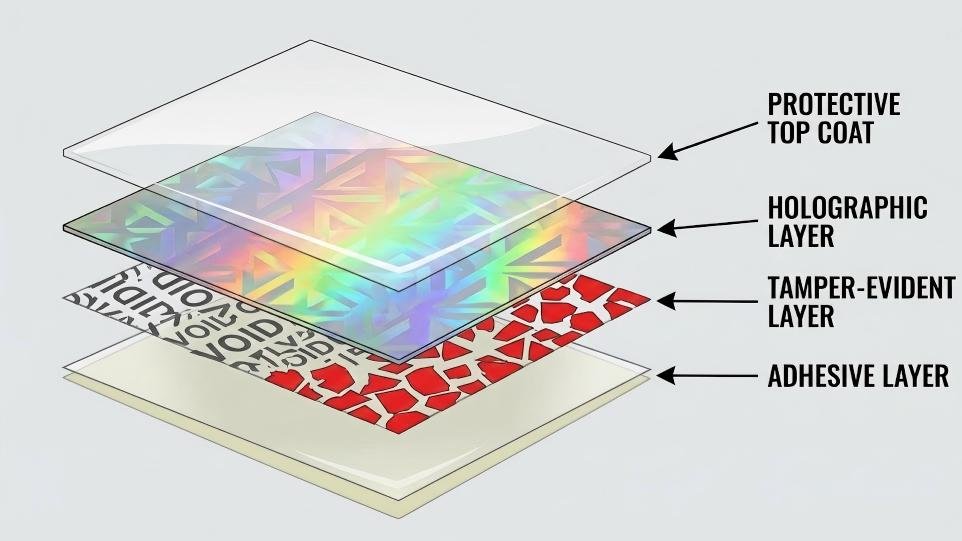
This isn't a normal sticker. It's a multi-layered security laminate engineered to fuse with the paper substrate of the data page. The goal is to make the sticker and your personal data one inseparable entity, creating an irreversible bond.
The key insight I always share with clients is to stop thinking of it as a sticker and start thinking of it as a transparent vault door. Its entire existence is dedicated to protecting what's underneath it—your photo, your name, your date of birth. Its complexity is hidden by design. If it were thick and obvious, it might be easier to defeat. Its thin, integrated nature is what makes it so effective. We are not just sticking a label on paper; we are fundamentally changing the properties of that paper.
It's a Permanent Fusion, Not a Temporary Bond
The science behind this is fascinating. Unlike a regular sticker that uses a simple pressure-sensitive adhesive, these security laminates often use specialized adhesives and materials that react with the paper fibers and ink.
| Feature | Regular Sticker | Passport Security Laminate |
|---|---|---|
| Purpose | To label or decorate. | To permanently protect data. |
| Adhesive | Removable or basic permanent. | Aggressive, specialized adhesive designed to fuse. |
| Removal | Can often be peeled off, sometimes with residue. | Self-destructs, delaminates, or leaves a permanent "VOID" pattern. |
| Structure | Single layer. | Multi-layered (laminate, hologram, tamper-evident features). |
This process of lamination creates a permanent integration between the protective layer and the document. Any attempt to undo this fusion results in the visible destruction of the sticker or the passport page itself.
Why Are Tamper-Evident Features Crucial for Passport Security?
Your passport data page is a primary target for identity thieves. They could try to skillfully swap your photo with someone else's. Without the right protection, this alteration could go undetected by border agents.
Tamper-evident features are the silent guardians of your identity. They don't stop a criminal from trying to alter the document, but they ensure that the attempt itself leaves behind an undeniable, permanent scar, immediately voiding the passport.
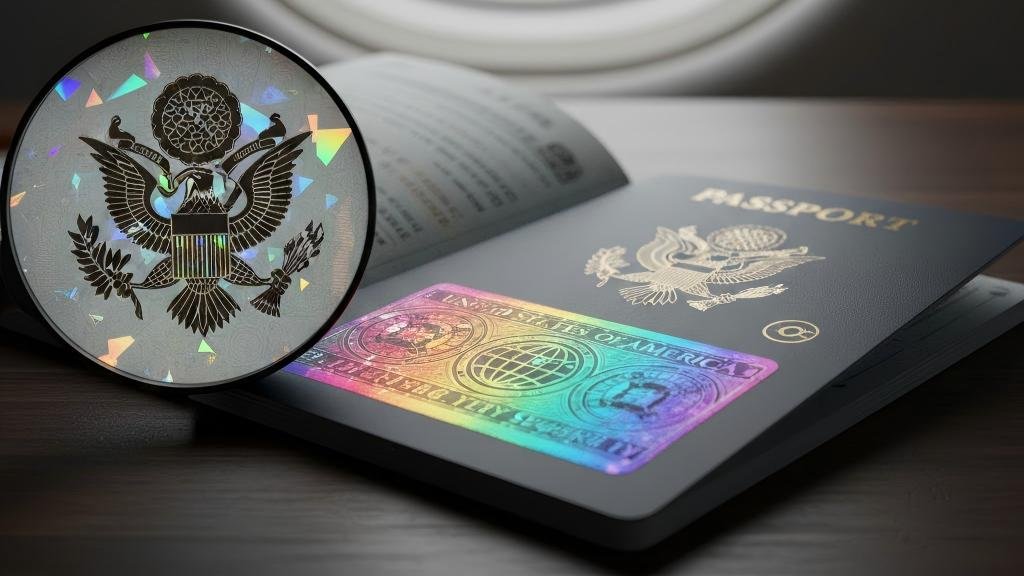
These features are the core of document security. The goal is to make any tampering attempt so obvious that it doesn't require a special tool to detect; the damage is visible to the naked eye. I once examined a counterfeit document where the forger tried to use heat to lift the laminate. The result wasn't a clean removal, but a shriveled, melted mess. The sticker did its job perfectly—it self-destructed at the first sign of attack, turning a $10,000 counterfeit operation into a worthless piece of plastic.
From Alteration to Annihilation
The principle is simple: make the cost of tampering too high. A forger's goal is a clean alteration. Tamper-evident technology makes this impossible.
- Delamination: Instead of peeling off in one piece, the sticker separates into its distinct layers, destroying the holographic image and leaving a fragmented film behind.
- Substrate Destruction: The adhesive is so strong that trying to pull off the sticker rips the paper fibers of the passport page itself, taking the printed data with it.
- Pattern Release: The most common method. The adhesive layer is pre-patterned with text like "VOID," "STOP," or a custom symbol. When the sticker is lifted, the pattern separates, leaving part of it on the document surface and creating voids in the sticker itself. The damage is irreversible.
This is a form of passive security; it doesn't need power or active monitoring. It sits there, waiting, and its one and only function is to fail catastrophically if tampered with.
How Do Holographic Security Stickers Prevent Document Fraud?
A simple transparent sticker can be replicated. How do you create something that is extremely difficult for counterfeiters to copy? The answer lies in the complexity and visual uniqueness of holography.
Holograms add a layer of security that is both easily verifiable by a non-expert and incredibly difficult to forge. They work because their creation requires highly specialized, expensive equipment and expertise that are far beyond the reach of most counterfeit operations.
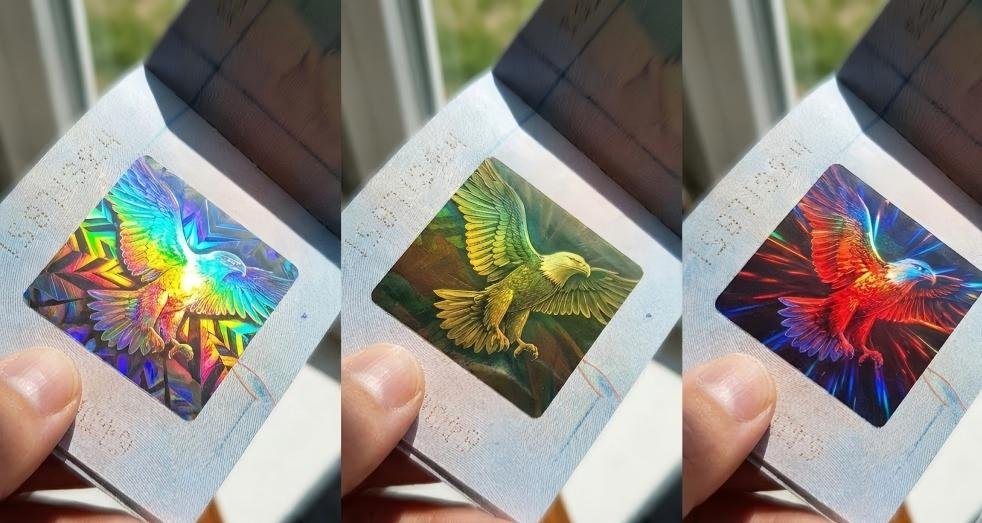
The magic of a hologram is in its optical complexity. It’s not a printed image. It’s a microscopic, three-dimensional recording of light patterns. When I show clients a true hologram, I ask them to tilt it. They see colors shift, images move, and hidden information appear and disappear. This is called kinematic effect. A simple printed copy won't do this; it will look flat and lifeless. This simple "tilt test" is one of the most effective anti-counterfeiting measures available. A border agent can perform this check in two seconds, instantly verifying authenticity without any special equipment.
The Layers of Holographic Deception
High-security holograms aren't a single image. They are a composite of multiple visual effects, each adding a barrier to counterfeiting.
- 2D/3D Effect: The background may appear flat while a central image (like a country's coat of arms) appears to float above it.
- Kinematic Effects (Movement): As you tilt the document, images seem to move or animate. For example, a line of text could scroll across the image.
- Microtext: Tiny text, often less than 0.2 mm high, is embedded within the holographic design. It's invisible to the naked eye but can be read with a simple magnifying glass. This is nearly impossible to replicate with standard printing.
- Covert Features (Hidden Images): Some holograms contain elements that are only visible when illuminated with a laser pointer. This is a level of security for forensic experts.
Each of these features adds another wall for the counterfeiter to climb, making replication prohibitively expensive and time-consuming.
The Different Types of Passport Security Technologies Available?
While the holographic sticker is the most visible security element, it's just one piece of a much larger puzzle. Modern passports use a layered approach, combining multiple technologies to create a document that is secure from both physical and digital attacks.
The best passport security strategy integrates overt (visible), covert (hidden), and forensic-level features. These technologies can be embedded in the paper, the ink, the laminate, and now, even in a microchip. This creates a multi-barrier defense system.
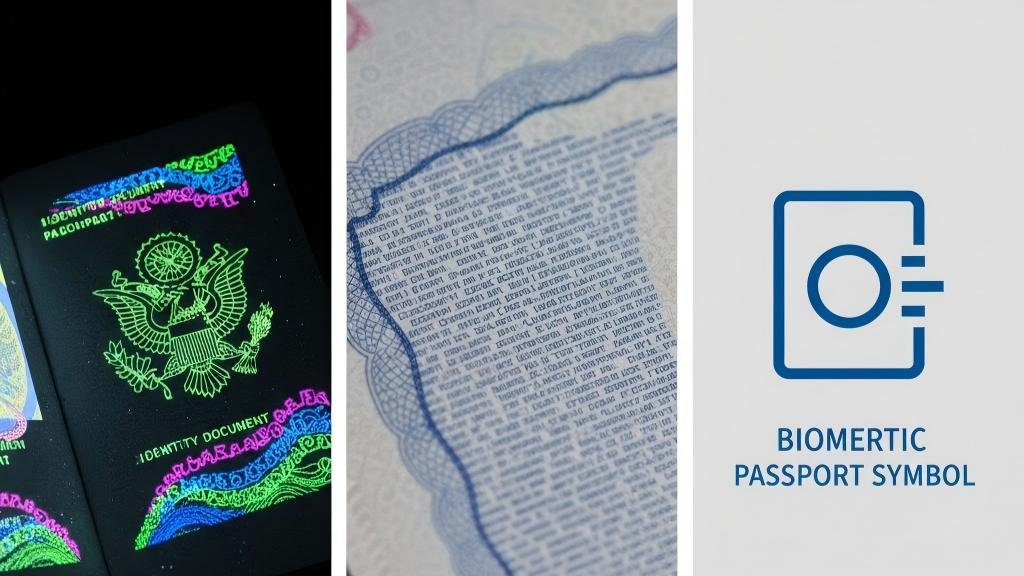
In my experience, no single technology is foolproof. I've seen beautifully made fake documents that replicate one or two features perfectly. However, I have never seen a fake that successfully replicates all the security features of a modern passport. The complexity is the key. The counterfeiter might be able to copy the hologram, but do they also have the special UV ink? Can they replicate the unique sewing thread in the binding? Probably not. It’s the combination of these technologies, each reinforcing the others, that creates a truly robust defense against fraud.
A Layered Defense Strategy
It's helpful to think of passport security in three distinct levels of verification.
| Technology Type | Examples | How It Works |
|---|---|---|
| Overt (Level 1 - Visible) | Holograms, Color-shifting ink, Watermarks, Security thread in the binding. | Easily verifiable by the public and border agents with no tools. A quick visual inspection. |
| Covert (Level 2 - Hidden) | UV-fluorescent inks, Microtext. | Hidden from plain sight. Requires simple tools like a UV light or a magnifying glass to verify. |
| Forensic (Level 3 - Expert) | Unique chemical taggants in the paper or ink, specific fiber composition. | Only detectable in a lab setting by forensic experts. Used for high-level criminal investigations. |
| Digital (e-Passport) | Biometric chip (RFID) containing the holder's photo and data. | The chip's data is digitally signed, preventing alteration. It can be read electronically to verify the physical document. |
A modern passport is a symphony of these technologies working together.
Key Features to Look for in a High-Quality Passport Sticker?
You're a government agency or a high-security printer. You're sourcing a security laminate. How do you distinguish a truly effective one from a mediocre imitation? The devil is in the details, and overlooking them can compromise an entire nation's document security.
A high-quality sticker must excel in two areas: its tamper-evident features must be immediate and aggressive, and its holographic elements must be complex and clear. It should be designed for abuse—it must fail perfectly when attacked.
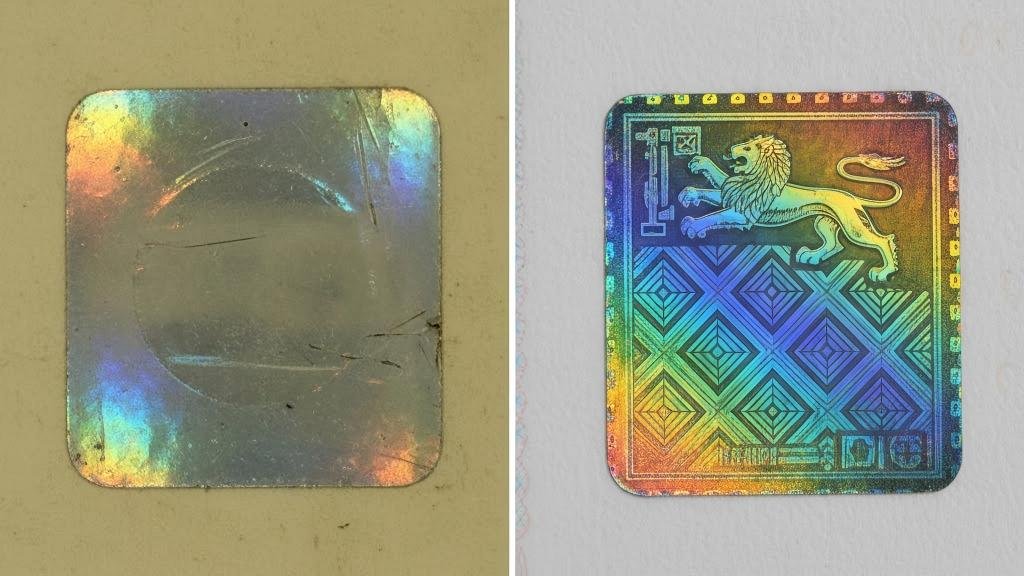
When I'm evaluating a potential security sticker for a client, I don't just look at it. I try to destroy it. I'll take a sample and try to peel it with a razor blade. I'll apply heat. I'll use solvents. I want to see how it dies. Does it come apart in messy, impossible-to-reassemble fragments? Does it leave a clean, undeniable "VOID" message? Is the paper underneath it destroyed? A passive failure is a failure of the product. I'm looking for a catastrophic, loud, and obvious failure. That's the sign of a high-quality product.
The Definitive Checklist for Security Laminates
When sourcing or specifying security stickers, here are the non-negotiable features you must demand.
Tamper-Evident Properties:
- Aggressive Adhesive: The laminate should fuse with the paper and ink, not just stick to it.
- Destructive Tampering Evidence: Must feature a robust tamper mechanism, such as a full-release "VOID" pattern, delamination, or substrate destruction. It shouldn't just leave a sticky residue; it must leave undeniable proof.
- Resistance to Solvents & Heat: The materials must not peel cleanly when exposed to common chemicals or moderate heat. They should blister, shrink, or otherwise deform in a way that shows attack.
Holographic and Visual Quality:
- Holographic Brightness & Clarity: The holographic image should be bright, sharp, and easily visible under various lighting conditions. A dim or fuzzy hologram is a red flag for poor quality.
- Multi-layered Complexity: Look for a combination of visual effects like 2D/3D depth, kinematic movement, and microtext. A simple, single-layer hologram is easier to counterfeit.
- Durability: The laminate must be resistant to abrasion, moisture, and wear-and-tear from daily handling, ensuring the security features remain intact for the 5-10 year life of the passport.
Sourcing a sticker based on price alone is a massive mistake. The real cost is measured in the potential for fraud that a low-quality product enables.
Conclusion
A passport security sticker is not decoration; it's a critical defense mechanism. Its purpose is to irreversibly bond with your data and dramatically fail if attacked, providing a clear warning of tampering.
Secure Your Documents with Confidence
At ProtegoSeal, we live and breathe security technology. We understand that the strength of a document lies in its layers of defense. Contact us to explore tamper-evident and holographic solutions that provide uncompromising protection for your most critical assets and documents.