Imagine a flight delayed for two hours simply because a plastic seal on a duty-free trolley was found broken during a routine pre-flight check. This is not just a logistical annoyance; it is a security breach that triggers a mandatory, full-cabin search by authorities.
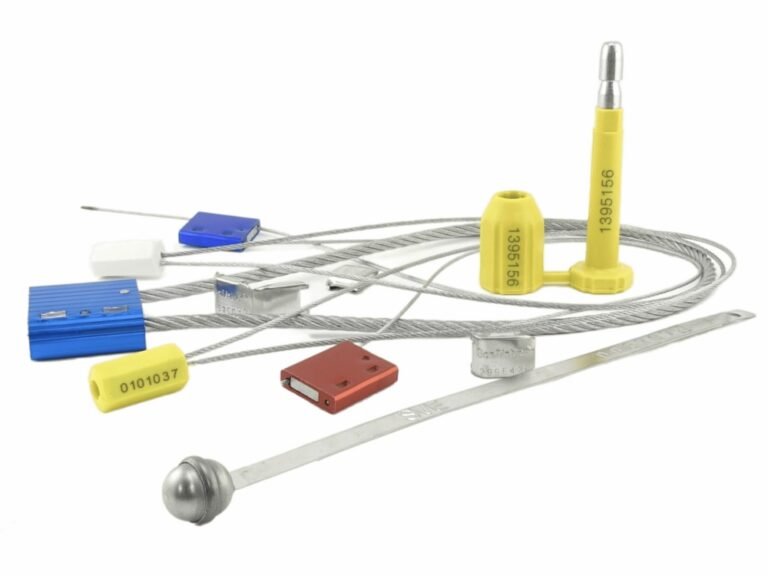
Aviation Security Seals are the critical line of defense in in-flight catering. They ensure the integrity of food, beverages, and high-value duty-free goods. More importantly, they prevent the introduction of prohibited items into the aircraft. These seals are designed to balance high security with the operational need for speed, allowing cabin crew to access supplies without tools while providing irrefutable evidence of any unauthorized access.

For airline procurement directors, choosing the right seal is not about buying generic plastic; it is about ensuring that your fleet moves without regulatory friction. Let’s examine the technical and operational standards required for 2026.
Regulatory Compliance: Meeting ICAO and Customs Standards for In-Flight Catering?
Are your current seals actually compliant with international aviation laws, or are you operating in a grey area? The consequences of non-compliance range from heavy fines to valid license suspensions.
Compliance in aviation is binary: you are either secure, or you are a risk. ICAO (International Civil Aviation Organization) sets the global baseline, but local customs authorities enforce the strict rules regarding "bonded" stores.

The Legal Weight of a Plastic Seal
In my years working with airline suppliers, I have seen shipments rejected because the seal number didn't match the manifest format required by the local authority.
The regulatory landscape requires three key elements:
- Traceability: Every seal must have a unique serial number. Duplicate numbers are a security failure. The data must be logged in the catering management system before the trolley leaves the kitchen.
- Tamper Evidence: It is not enough for the seal to lock; it must show clear visual signs if someone tried to attack it with heat or a shim.
- Material Safety: The seal material such as Polypropylene must be food-safe and fire-retardant standard, as these trolleys are stored inside the aircraft cabin.
When you supply seals to an airline, you are helping them meet TSA (Transportation Security Administration) or EASA requirements. The seal is a legal declaration that "This cart was screened and hasn't been touched since."
Why Plastic Padlock Seals are the Industry Standard for Trolleys and ATUs?
Why does the aviation industry almost universally use the "Padlock" style seal instead of a pull-tight seal? It comes down to a specific engineering challenge: the Calibration of Break Strength Threshold.
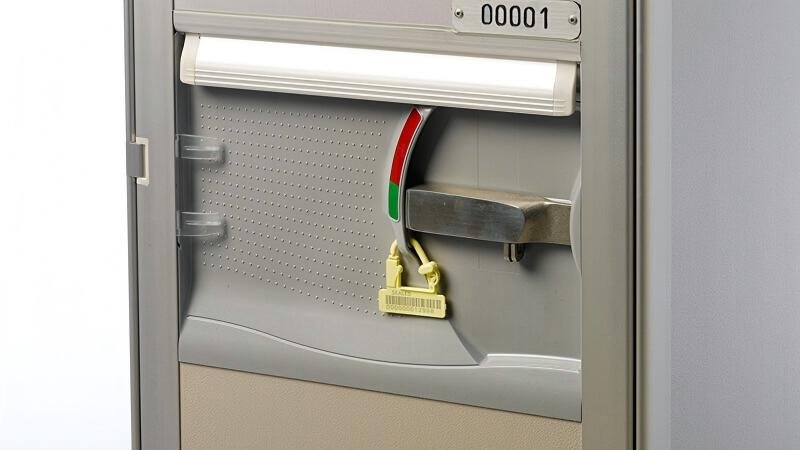
Plastic Padlock Seals are the industry standard because they solve a unique contradiction in the cabin environment. They must be weak enough to be broken by a flight attendant's bare hands during service, but strong enough to survive the violent impacts of a trolley rattling down a runway.
The Engineering of "Just Right"
This is where the manufacturing quality makes a massive difference.
- The Conflict: If you make the seal too strong (e.g., 10kg break force), the cabin crew cannot open it when passengers are waiting for dinner. They don't carry scissors. If they try to twist it and hurt their hands, they will file a union complaint.
- The Risk: If you make the seal too weak (e.g., under 1kg break force), the natural vibration of the aircraft or the impact of carts bumping into each other in the galley will snap the seal. This is a disaster. A broken seal on a bonded liquor cart means the entire inventory is suspect and often must be discarded or re-screened.
- The Solution: We utilize a precise Tensile Testing) process to calibrate the break point. The "shackle" of the padlock is engineered with a specific weak point that withstands compression (bumps) but yields to torsion (twisting). This "Calibration of Break Strength Threshold" is the critical technology that prevents flight delays.
Operational Protocols: Correct Application to Prevent Accidental Breakage in Tight Galleys?
Even the best seal will fail if it is applied incorrectly. In the cramped space of an aircraft galley, "accidental breakage" is a frequent and costly pain point for airlines.
Operational protocols must be standardized. A loose seal is a liability. The seal must be applied so that it lays flat against the recess of the trolley lock, minimizing its profile so it doesn't snag on passing uniforms or equipment.
Reducing the "Snag Risk"
I often conduct training sessions with catering crews to fix this.
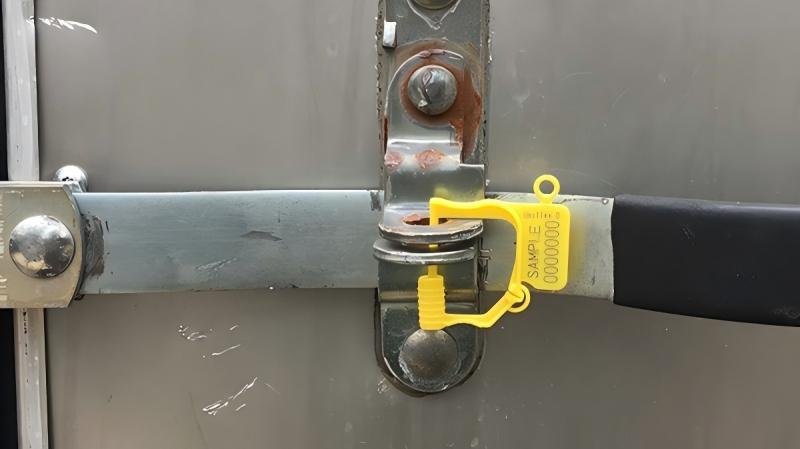
- The Orientation: The body of the padlock seal should face outward, but the hasp (the loop) should not dangle freely.
- The "Click": Crews must push the hasp until they hear a distinct "click." A seal that hasn't fully engaged is useless.
- The Rotation: After locking, rotate the seal body 180 degrees to tuck it behind the latch handle if possible.
In a busy galley, a trolley might hit the bulkhead. If the plastic seal is protruding, it acts like a bumper and snaps. By training staff to position the seal in the "protected zone" of the latch recess, we reduce accidental breakage by significant margins. This small procedural change saves airlines thousands of dollars in "false alarm" investigations.
Visual Management: Using Color-Coding for Inbound and Outbound Flight Logistics?
How does a ground handler know instantly if a trolley is full of tax-free alcohol or just empty trash? They don't read the barcode; they look at the color.
Visual management via color-coding is not just for organization; it is a Direct Mapping of Customs Control Status. The color of the seal is an immediate signal to authorities regarding the tax status and security level of the goods inside.

Color as a Legal Status
In my insight, this is the most undervalued aspect of seal selection.
- Red Seals (High Risk/Bonded): Typically used for duty-free alcohol, perfume, and cigarettes. This color screams "Stop" to customs. It implies that these goods have not paid local taxes and must remain sealed while on the ground.
- Green/Yellow Seals (Low Risk/Dry Stores): Used for blankets, headsets, or dry food. These are less regulated.
- The Operational Impact:
When a plane lands, the cleaning crew enters. If they see a Red Seal, they know: "Do not open." If they see a Green Seal, they know: "Replenish this."
This Direct Mapping prevents the accidental mixing of bonded and non-bonded goods. If a crew member accidentally puts a domestic soda can into an international bonded cart, the airline can face a customs audit. Strict color coding acts as a visual firewall, allowing operations to flow repeatedly and quickly without reading tiny serial numbers.
The Inspection Checklist: A 3-Step Guide for Crew to Verify Seal Integrity?
Trust, but verify. How can a flight attendant be sure the seal hasn't been glued back together by a clever thief?
The inspection checklist must be part of the pre-flight routine. It is a simple 3-step physical audit: Verify, Inspect, and Twist. This routine ensures that the visual chain of custody remains unbroken from the catering kitchen to the passenger's tray table.

The "VIT" Protocol
I advise airlines to print this simple logic into their crew manuals:
- Verify (The Number): Look at the seal number. Does it match the catering papers? If the paper says "Seal 123" and the trolley has "Seal 124," do not depart. That trolley could contain anything.
- Inspect (The Mechanism): Look closely at the locking chamber. are there white stress marks on the plastic? This indicates someone tried to force it open. Is there any residue like superglue? This is a sign of tampering.
- Twist (The Integrity): Give the seal a gentle tug or twist. A compromised seal that has been glued back together will just pop open with light pressure. A genuine seal will feel solid.
This 10-second check prevents the nightmare scenario of discovering a theft mid-flight, when nothing can be done about it.
Conclusion
Aviation security is a game of details. By utilizing Plastic Padlock Seals with a calibrated break strength, airlines can ensure security without compromising service speed. The key lies in using color as a Direct Mapping of Customs Status and adhering to strict inspection protocols.
Secure Your Fleet with ProtegoSeal
Don't let a fast break slow down your flight. At ProtegoSeal, we specialize in Plastic Padlock Seals engineered specifically for the aviation industry. Our seals offer the perfect balance of tensile strength and user-friendliness, fully customizable to your color-coding needs. Contact us today to request samples for your catering operations.